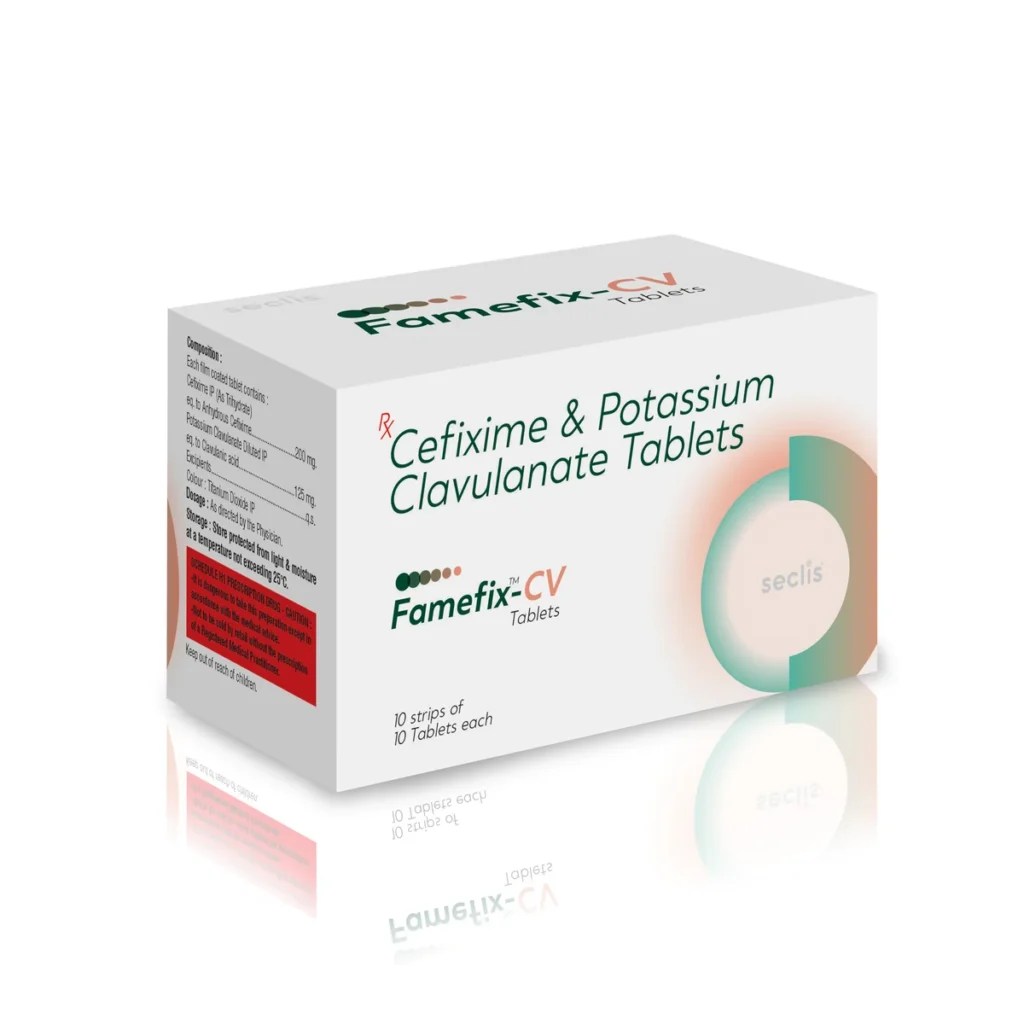
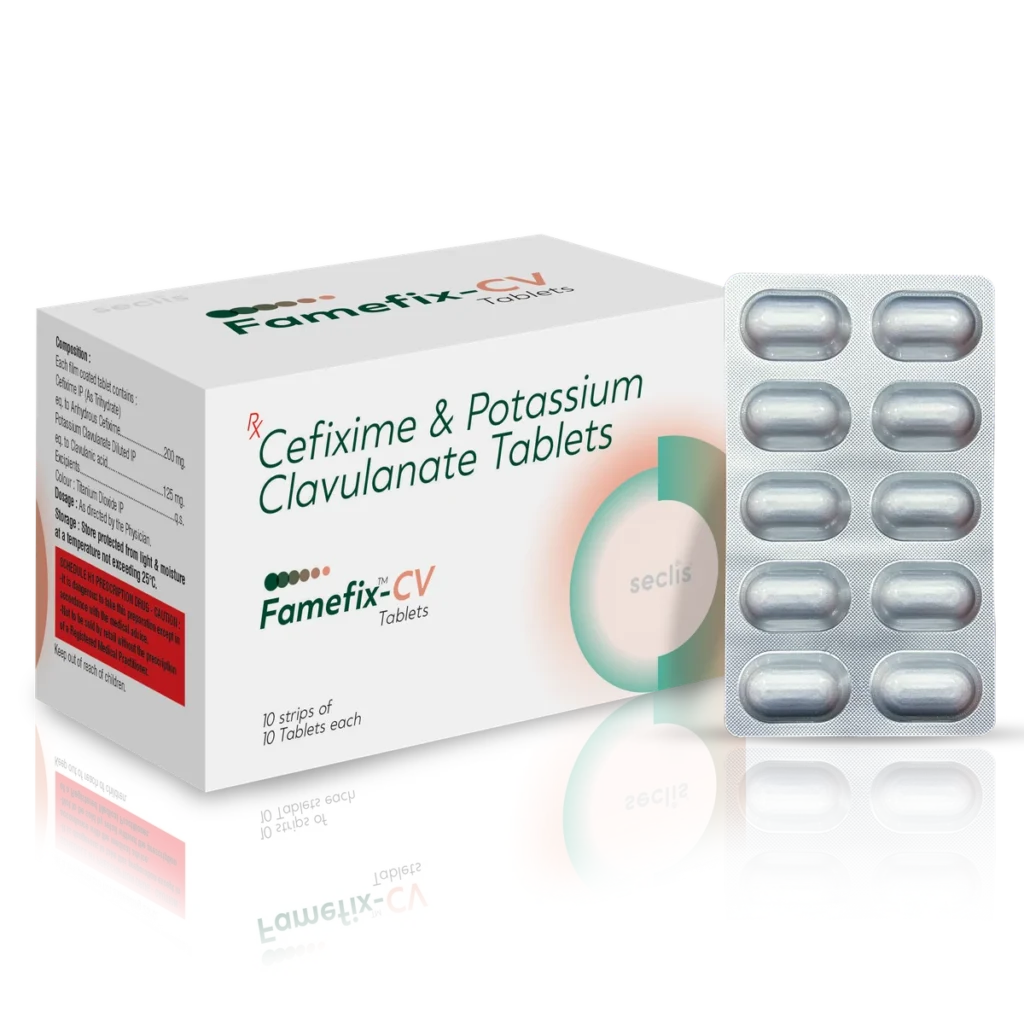
FAMEFIX™ CV
Cefixime 200mg + Clavulanic Acid 125mg
Quick Facts
Key Benefits
Mechanism of Action
Cefixime 200mg + Clavulanic Acid 125mg is a novel combination pairing a third-generation cephalosporin with a beta-lactamase inhibitor — creating an anti-resistance formulation that extends cefixime's already-broad gram-negative spectrum to cover beta-lactamase-producing organisms that would otherwise inactivate plain cefixime.
Cefixime (200mg) binds to penicillin-binding proteins (PBPs) — specifically PBP1 and PBP3 — blocking peptidoglycan cross-linking and causing bacterial cell wall failure. Its third-generation characteristics provide high intrinsic stability against many beta-lactamases, but certain plasmid-mediated extended-spectrum beta-lactamases (ESBLs) and AmpC enzymes can overcome this stability.
Clavulanic Acid (125mg) irreversibly inactivates a broad range of beta-lactamase enzymes by forming a stable acyl-enzyme complex that permanently inhibits beta-lactamase activity. By protecting cefixime from enzymatic degradation, clavulanate extends coverage to include ESBL-producing organisms that would otherwise be resistant to standard cefixime, as well as beta-lactamase-producing H. influenzae, M. catarrhalis, and S. aureus strains.
This is a pharmacologically rational combination — unlike amoxycillin-clavulanate (which uses an older-generation penicillin), cefixime-clavulanate combines a third-generation cephalosporin with beta-lactamase protection, offering broader gram-negative spectrum with ESBL resistance coverage.
Indications
FAMEFIX™ CV is indicated for moderate-to-severe infections caused by beta-lactamase-producing organisms where standard cefixime or co-amoxiclav would be inadequate.
ENT Infections (Primary): Recurrent or severe acute otitis media, complicated sinusitis, and tonsillitis unresponsive to standard cephalosporins — particularly where ESBL-producing H. influenzae or resistant M. catarrhalis is isolated or suspected.
Respiratory Infections: Community-acquired pneumonia with suspected beta-lactamase-producing gram-negative pathogens, acute exacerbations of chronic bronchitis, and bronchiectasis-associated infections.
Urinary Tract Infections: Complicated UTIs, pyelonephritis, and recurrent UTIs caused by ESBL-producing E. coli and Klebsiella — the most rapidly growing indication for cefixime-clavulanate in India given the high ESBL prevalence in community UTI isolates.
Gynaecological Infections: Complicated pelvic inflammatory disease and urogenital infections with resistant gram-negative pathogens.
Second-Line ENT and Respiratory: Infections where co-amoxiclav (amoxycillin-clavulanate) has failed, where cefixime's extended gram-negative spectrum offers clinical advantage.
Dosage & Administration
Dosage and administration should be as prescribed by a qualified doctor or medical professional. Do not self-medicate. Always follow your physician's instructions regarding dose, frequency and duration of treatment.
Why FAMEFIX™ CV?
ESBL-producing E. coli now accounts for over 50% of community-acquired UTI isolates in many Indian cities — a statistic that has fundamentally changed outpatient antibiotic prescribing. Standard cefixime, which was previously reliable for most gram-negative UTIs, is increasingly failing against ESBL strains. FAMEFIX™ CV addresses this directly by adding clavulanate protection to cefixime, restoring activity against organisms that beta-lactamase resistance has rendered cefixime-susceptible only on paper.
For ENT specialists managing recurrent otitis media and sinusitis in patients with prior antibiotic courses, the emergence of beta-lactamase-producing H. influenzae as a treatment failure driver makes the cefixime-clavulanate combination a rational empirical step-up from co-amoxiclav. The third-generation cephalosporin backbone of FAMEFIX™ CV provides superior gram-negative coverage compared to the aminopenicillin backbone of co-amoxiclav — a meaningful clinical advantage for gram-negative-predominant ENT and urological infections.