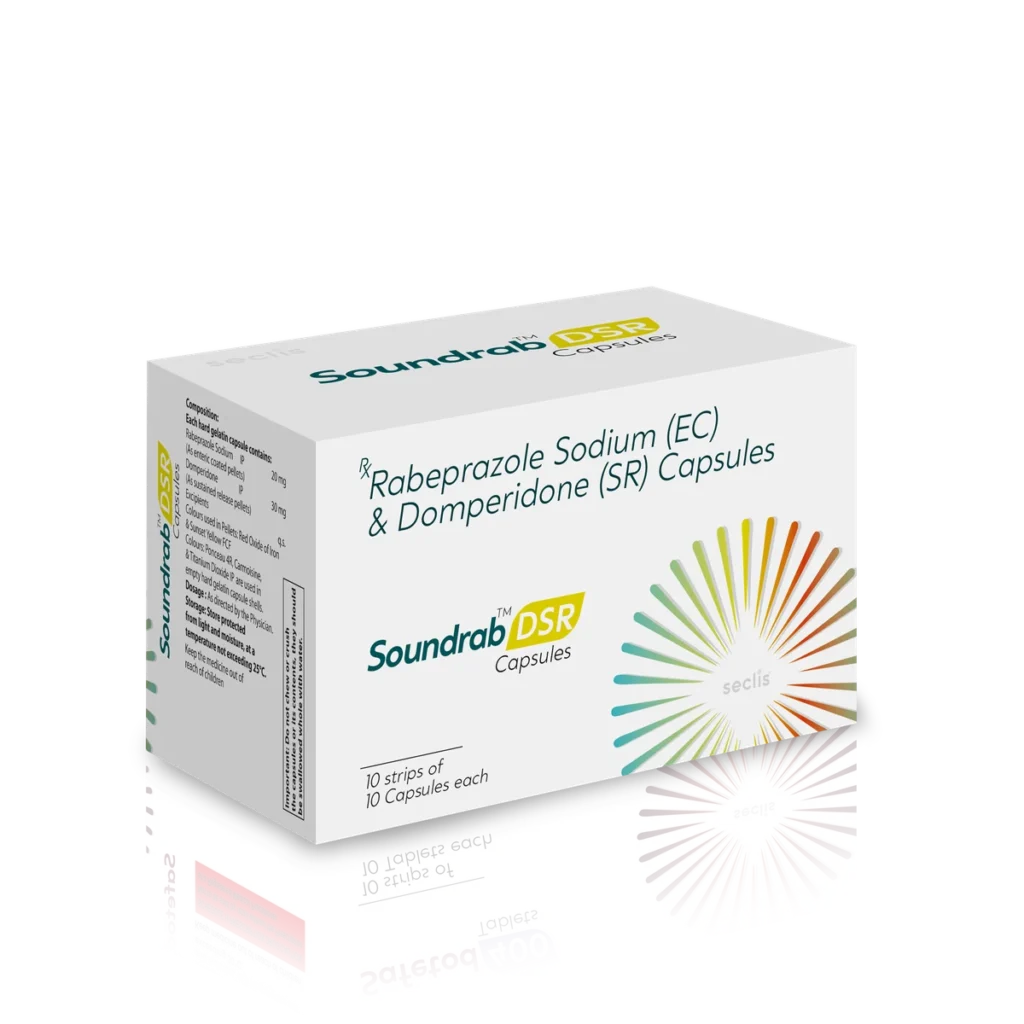
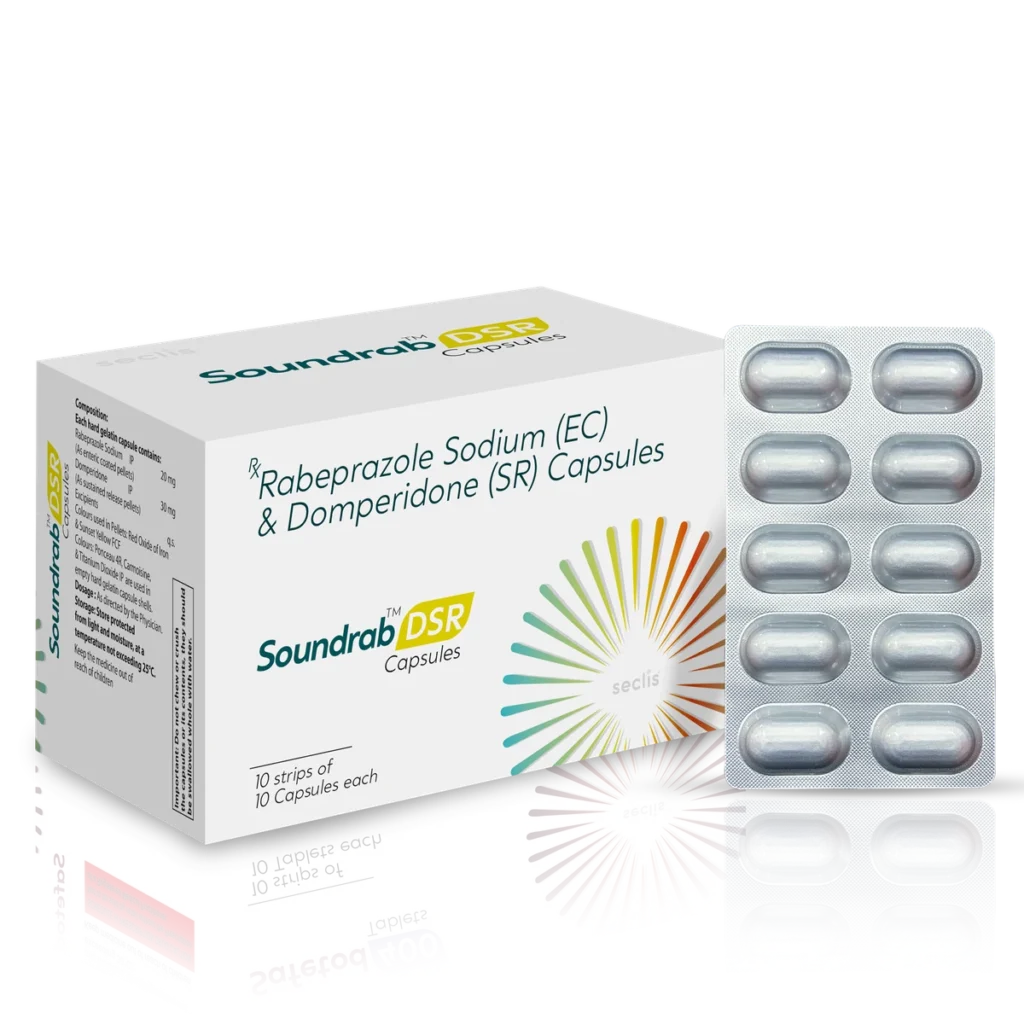
SOUNDRAB™ DSR
Rabeprazole 20mg (EC)+ Domperidone 30mg (SR) (WHO GMP Certified)
Quick Facts
Key Benefits
Mechanism of Action
SOUNDRAB™ DSR is a dual-release capsule combining two complementary mechanisms targeting both acid hypersecretion and gastric motility dysfunction — the two pathophysiological drivers of most upper GI disorders.
Rabeprazole 20mg (Enteric Coated, EC): Rabeprazole is a second-generation benzimidazole proton pump inhibitor (PPI) that irreversibly inhibits H⁺/K⁺-ATPase on the gastric parietal cell's luminal membrane. As a prodrug, rabeprazole is activated at low pH in the secretory canaliculus, where it converts to a sulphenamide that forms a covalent disulphide bond with cysteine residues on the proton pump, permanently inactivating it. What distinguishes rabeprazole from other PPIs is its higher pKa (5.0 versus 3.5–4.0 for omeprazole/pantoprazole), meaning it is activated at a higher pH and more rapidly. This pharmacological difference translates clinically to faster onset of acid suppression, more consistent intragastric pH elevation, and less inter-individual variability due to CYP2C19 polymorphism — a key advantage over omeprazole and pantoprazole whose efficacy varies significantly with CYP2C19 metaboliser status. The enteric coating bypasses gastric degradation, releasing rabeprazole in the small intestine for absorption.
Domperidone 30mg (Sustained Release, SR): Domperidone is a selective peripheral dopamine D2/D3 receptor antagonist with prokinetic and anti-emetic properties. Unlike metoclopramide (which crosses the blood-brain barrier), domperidone's poor CNS penetration restricts its dopamine antagonism to peripheral GI receptors and the chemoreceptor trigger zone (which lies outside the blood-brain barrier) — eliminating the extrapyramidal side effects that limit metoclopramide use. In the GI tract, domperidone blocks D2 receptors in the gastric antrum and duodenum, removing dopaminergic inhibition of acetylcholine release and restoring coordinated antroduodenal peristalsis. This accelerates gastric emptying, reduces post-prandial bloating, and increases lower oesophageal sphincter tone. The SR formulation releases domperidone over 12 hours — maintaining therapeutic plasma levels throughout the post-prandial period without the peak-trough fluctuations of immediate-release domperidone.
Indications
SOUNDRAB™ DSR addresses the combined acid-motility pathophysiology of upper GI disorders where standard PPI monotherapy provides incomplete relief.
GORD with Gastroparesis (Primary Indication): Gastro-oesophageal reflux disease complicated by delayed gastric emptying — a common combination where reduced gastric emptying increases intragastric volume and pressure, perpetuating reflux despite adequate acid suppression. Rabeprazole reduces acid exposure; domperidone SR addresses the mechanical reflux driver.
Functional Dyspepsia: Post-prandial distress syndrome characterised by bloating, early satiety, nausea, and epigastric discomfort — driven by both acid sensitivity and impaired gastric accommodation/emptying.
Peptic Ulcer Disease: Gastric and duodenal ulceration — rabeprazole accelerates ulcer healing through superior acid suppression; domperidone reduces nausea and vomiting associated with peptic disease.
Laryngopharyngeal Reflux (LPR): Extraoesophageal reflux causing chronic throat clearing, hoarseness, and post-nasal drip — a frequent ENT indication where combined acid suppression and prokinetic therapy outperforms PPI monotherapy.
Nausea and Vomiting Management: Post-chemotherapy nausea (domperidone at the CTZ) combined with oesophageal/gastric acid-related symptoms.
Diabetic Gastroparesis: Accelerated gastric emptying from domperidone SR combined with acid suppression for concurrent GORD in diabetic patients.
Dosage & Administration
Dosage and administration should be as prescribed by a qualified doctor or medical professional. Do not self-medicate. Always follow your physician's instructions regarding dose, frequency and duration of treatment.
Why SOUNDRAB™ DSR?
Among the PPI class, rabeprazole's pharmacokinetic profile — activation at a higher pH, faster onset, and minimal dependence on CYP2C19 metaboliser phenotype — makes it the preferred PPI for patients who have experienced variable or inadequate acid suppression with omeprazole or pantoprazole. Approximately 20% of South Asian patients are rapid CYP2C19 metabolisers who degrade omeprazole and pantoprazole so quickly that standard doses provide inadequate acid suppression — rabeprazole's minimal CYP2C19 dependence overcomes this pharmacogenomic limitation.
The WHO-GMP certification highlighted on SOUNDRAB™ DSR packaging is a quality differentiator in the DSR combination market, which is populated with numerous manufacturers of variable quality. For franchise partners prescribing in gastroenterology-heavy territories, rabeprazole-domperidone DSR is consistently among the highest-volume upper GI prescriptions, with strong repeat prescribing from both patients and physicians.