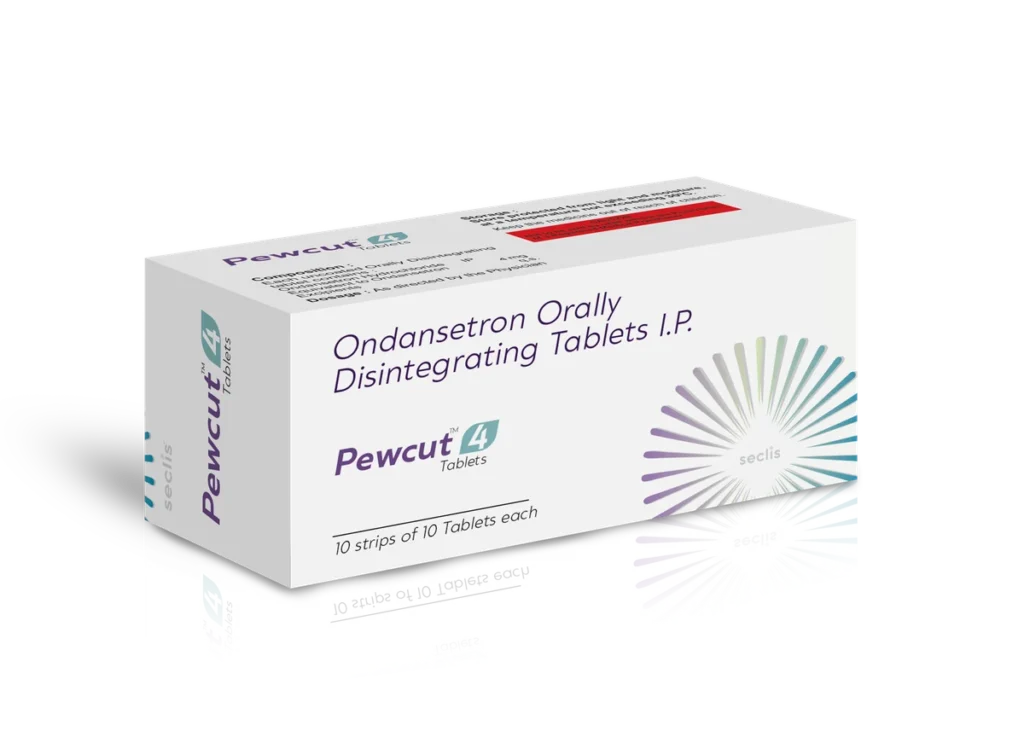
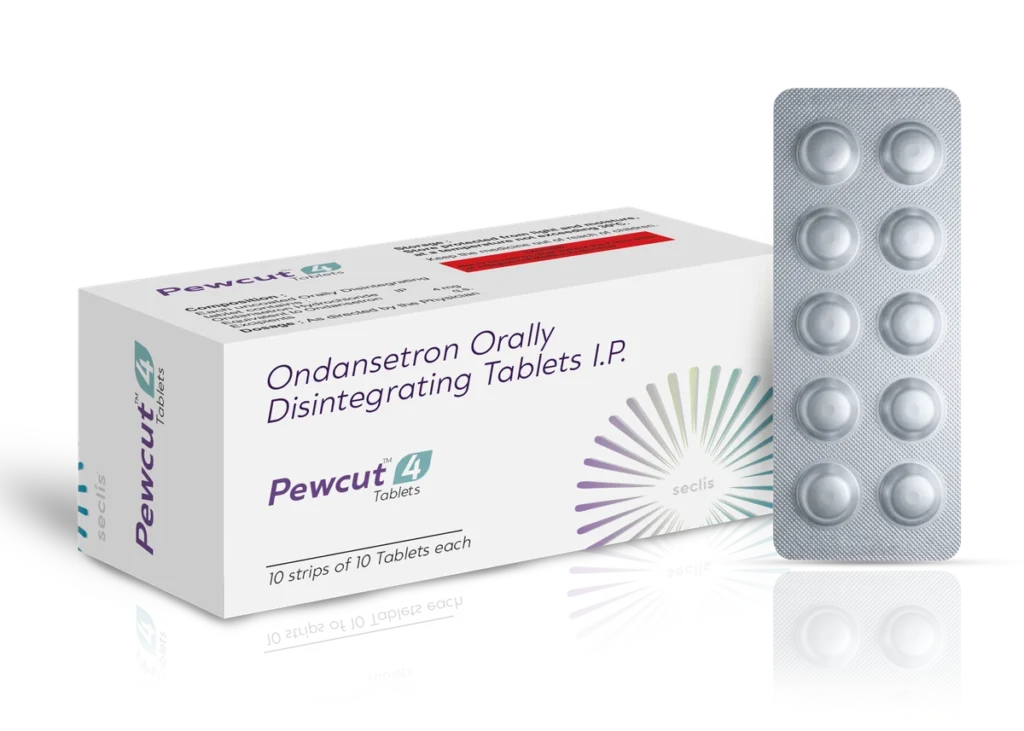
PEWCUT™ 4
Ondansetron 4mg Orally Disintegrating Tablet
Quick Facts
Key Benefits
Mechanism of Action
Ondansetron is a highly selective 5-HT3 (serotonin type 3) receptor antagonist — the first of its class and the most widely used anti-emetic in modern medicine. It blocks 5-HT3 receptors on peripheral vagal nerve terminals in the GI tract and on central neurons in the chemoreceptor trigger zone (CTZ) and nucleus tractus solitarius (NTS).
The mechanism of chemotherapy-induced, radiation-induced, and post-operative nausea/vomiting is primarily mediated by serotonin (5-HT) released from enterochromaffin cells in the gut mucosa in response to cytotoxic insult, radiation, or surgical trauma. This serotonin activates 5-HT3 receptors on vagal afferent fibres, triggering signals to the vomiting centre. Ondansetron blocks these 5-HT3 receptors at the peripheral vagal level (preventing the initial signal) and centrally at the NTS (preventing the integrated vomiting response), effectively interrupting the emetic reflex at both ends.
For acute gastroenteritis-associated vomiting (the most common paediatric indication), the mechanism involves serotonin released from gut enterochromaffin cells in response to the infectious or irritant stimulus — ondansetron's peripheral 5-HT3 blockade suppresses the afferent signal from gut to vomiting centre.
The Orally Disintegrating Tablet (ODT) formulation dissolves on the tongue within 30–60 seconds without requiring water — pharmacologically identical to standard tablets but critically enabling oral anti-emetic administration in actively vomiting patients who cannot swallow conventional tablets. The ODT is absorbed through the buccal mucosa as well as the GI mucosa, achieving faster peak plasma levels than conventional tablets.
Indications
PEWCUT™ 4 is indicated for nausea and vomiting across multiple clinical contexts — the ODT format making it particularly valuable where oral liquid administration is impractical.
Acute Gastroenteritis with Vomiting (Primary Paediatric Indication): Single or multiple ondansetron ODT doses dramatically reduce vomiting frequency in children with acute gastroenteritis, enabling oral rehydration therapy that would otherwise be impossible. Multiple randomised controlled trials demonstrate that a single ondansetron ODT dose reduces the need for IV rehydration and emergency department admissions in paediatric AGE.
Post-Operative Nausea and Vomiting (PONV): 4mg ondansetron is guideline-recommended for PONV prevention and treatment — the ODT format is particularly practical for post-operative patients where oral liquid intake may be restricted.
Chemotherapy-Induced Nausea and Vomiting: For mildly-emetogenic chemotherapy regimens, 4mg ondansetron ODT provides effective prophylaxis. For moderately/highly emetogenic regimens, 8mg ondansetron (two 4mg ODTs) may be used.
Radiation-Induced Nausea: Radiation to the abdomen and pelvis frequently causes severe nausea — ondansetron is first-line anti-emetic therapy.
Pregnancy-Associated Nausea and Vomiting: Ondansetron is increasingly used (with caution) for hyperemesis gravidarum when first-line antihistamines and vitamin B6 are insufficient.
General Nausea and Vomiting: Vestibular (motion sickness does not respond — ondansetron has no H1 or muscarinic activity) and drug-induced nausea from opioids, antibiotics, and other medications.
Dosage & Administration
Dosage and administration should be as prescribed by a qualified doctor or medical professional. Do not self-medicate. Always follow your physician's instructions regarding dose, frequency and duration of treatment.
Why PEWCUT™ 4?
Ondansetron ODT has transformed the management of paediatric acute gastroenteritis. Before ondansetron, children with persistent vomiting from AGE frequently required intravenous cannulation and hospital admission for IV rehydration — a traumatic and expensive intervention. A single ondansetron ODT reduces vomiting sufficiently to enable oral rehydration in most children, preventing hospitalisation in 70–80% of cases that would otherwise require IV therapy. The ODT format is the key enabler — placing a dissolving tablet on a vomiting child's tongue is far more practical and reliable than attempting to administer liquid oral rehydration salts in a child who vomits every attempt.
For oncology practices, ondansetron ODT provides an orally bioavailable anti-emetic for outpatient chemotherapy settings where patients are not hospitalised for IV ondansetron infusions. The efficacy for mildly-to-moderately emetogenic regimens is well-established.
PEWCUT™ 4's 10×10 pack (100 tablets) supports both institutional oncology dispensing and general practice/paediatric prescribing — two distinct market segments within a single product SKU.