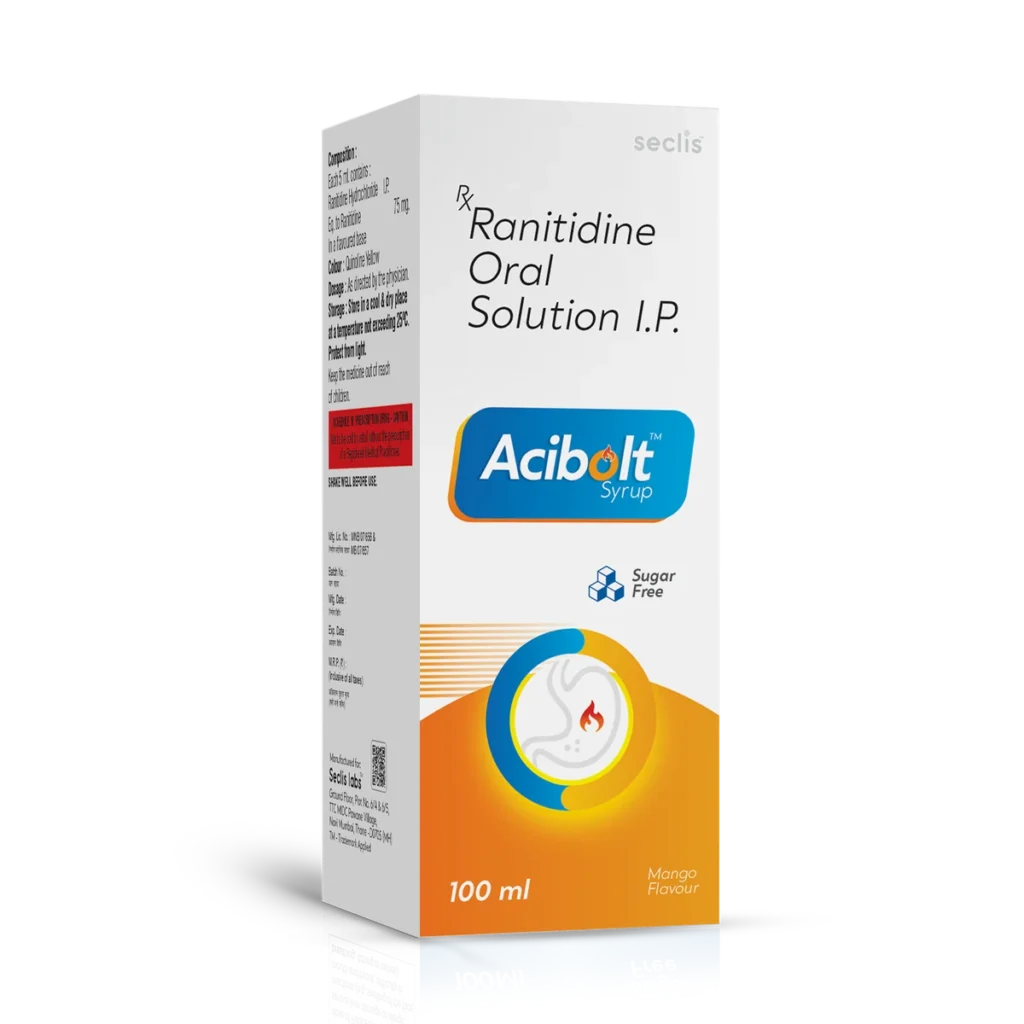
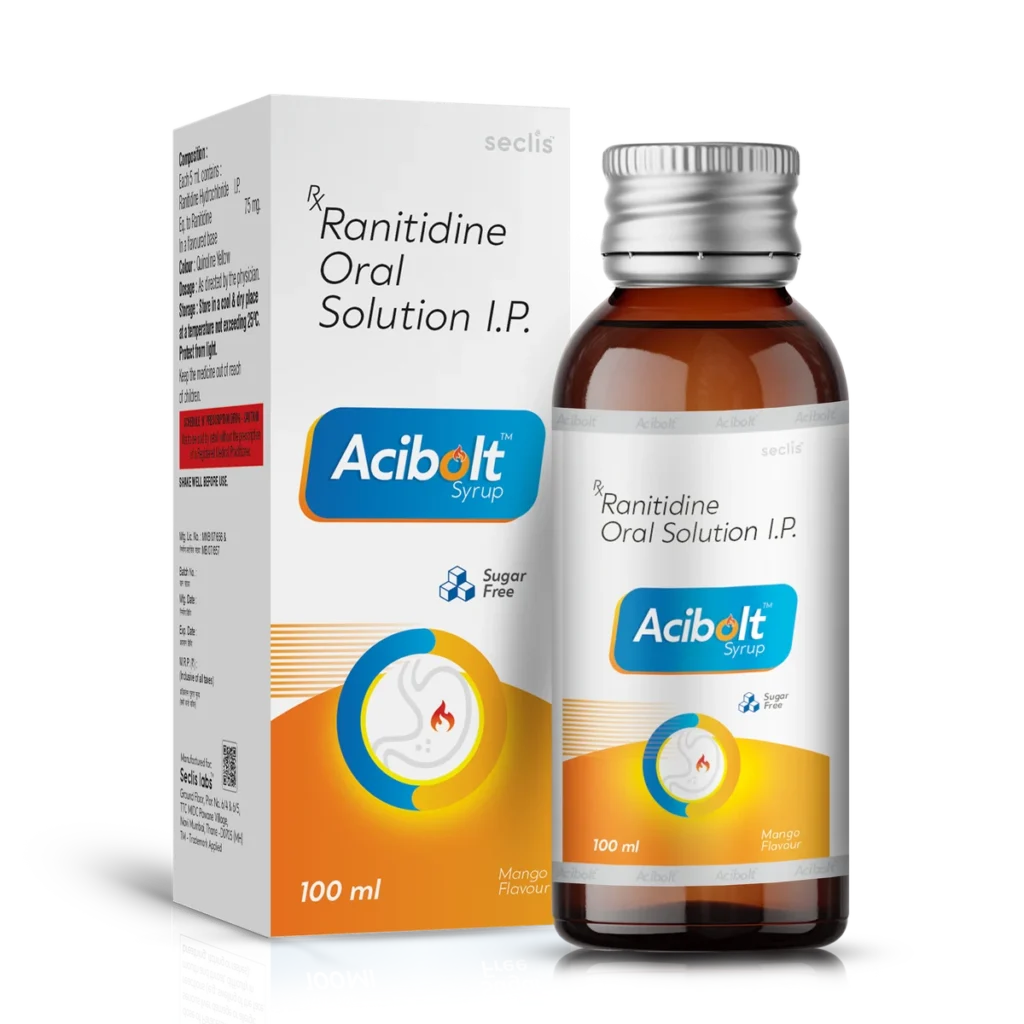
ACIBOLT™-75
Ranitidine 75mg
Quick Facts
Key Benefits
Mechanism of Action
Ranitidine is a competitive histamine H2-receptor antagonist — a different class of acid-suppressive agent from proton pump inhibitors, acting at an earlier and more reversible step in the acid secretion pathway.
Gastric parietal cells receive stimulatory signals from three sources: acetylcholine (via vagal nerves), gastrin (from G-cells), and histamine (from enterochromaffin-like cells). Of these, histamine-mediated stimulation through H2 receptors on the parietal cell is quantitatively the most significant pathway for acid secretion. Ranitidine competitively and reversibly blocks H2 receptors on the basolateral membrane of gastric parietal cells, preventing histamine-stimulated activation of adenylate cyclase and the subsequent cAMP-mediated activation of H⁺/K⁺-ATPase — reducing acid secretion without directly inhibiting the proton pump itself.
This mechanism produces important clinical characteristics distinct from PPIs: ranitidine's onset of acid suppression is faster (within 1 hour of an oral dose versus 2–4 hours for PPIs), its acid-suppressive effect is fully reversible (new H2 receptors are synthesised within 12 hours, unlike PPIs' covalent pump inhibition), and it is particularly effective at suppressing histamine-stimulated nocturnal acid secretion.
At 75mg per syrup formulation in 100mL, ACIBOLT-75 provides an H2-blocker in a liquid format particularly suited for paediatric patients, elderly patients with swallowing difficulty, and patients requiring on-demand acid relief where the liquid format enables faster gastric absorption than solid dosage forms.
Indications
ACIBOLT-75 is indicated for acid-related conditions where an H2-blocker's specific pharmacological advantages over PPIs are clinically relevant — particularly the faster onset, paediatric suitability, and OTC-accessible acid relief.
Paediatric GORD and Peptic Disease (Primary Indication for Syrup Format): Ranitidine syrup is suitable from birth (neonates and infants for GORD) — making it one of the few acid-suppressive agents approved at this age. The liquid format enables precise weight-based dose calculation essential for neonatal and infant acid-related conditions.
On-Demand Heartburn Relief: H2-blockers have a faster onset than PPIs for on-demand use — ranitidine 75mg provides meaningful acid suppression within 1 hour for breakthrough heartburn. The syrup form enables faster gastric absorption than tablets.
Peptic Ulcer Disease: Histamine-driven peptic ulceration (particularly nocturnal acid-mediated duodenal ulcers) — ranitidine's superior nocturnal acid suppression is relevant for predominantly nocturnal symptomatic duodenal ulcers.
GORD Maintenance (Mild): For mild GORD not requiring full PPI suppression, ranitidine provides proportionate acid control with a lower side-effect burden than chronic PPI use — particularly relevant given emerging concerns about long-term PPI associations with hypomagnesaemia, bone density reduction, and C. difficile risk.
Stress Ulcer Prophylaxis: In paediatric ICU patients, ranitidine remains an important stress ulcer prophylactic option, particularly for neonates where PPI safety data is more limited.
Dosage & Administration
Dosage and administration should be as prescribed by a qualified doctor or medical professional. Do not self-medicate. Always follow your physician's instructions regarding dose, frequency and duration of treatment.
Why ACIBOLT™-75?
In the era of proton pump inhibitor dominance, ranitidine syrup maintains a specific and irreplaceable role in two patient populations: neonates/infants with GORD (where PPIs have limited safety data and ranitidine remains the established acid suppressant), and patients requiring fast on-demand acid relief (where ranitidine's 1-hour onset outperforms PPIs' 2–4 hour delay).
The liquid format of ACIBOLT-75 is the key differentiator — enabling neonatal and infant weight-based dosing that solid ranitidine tablets cannot accommodate. For paediatric prescribers managing infant GORD and regurgitation, ranitidine syrup provides the most established and paediatric-validated oral acid suppressant available.
The accessibility of ACIBOLT-75 at ₹98 for 100mL — sufficient for approximately 2 weeks of twice-daily paediatric treatment — supports broad paediatric prescribing without financial barriers for families managing infant acid reflux.