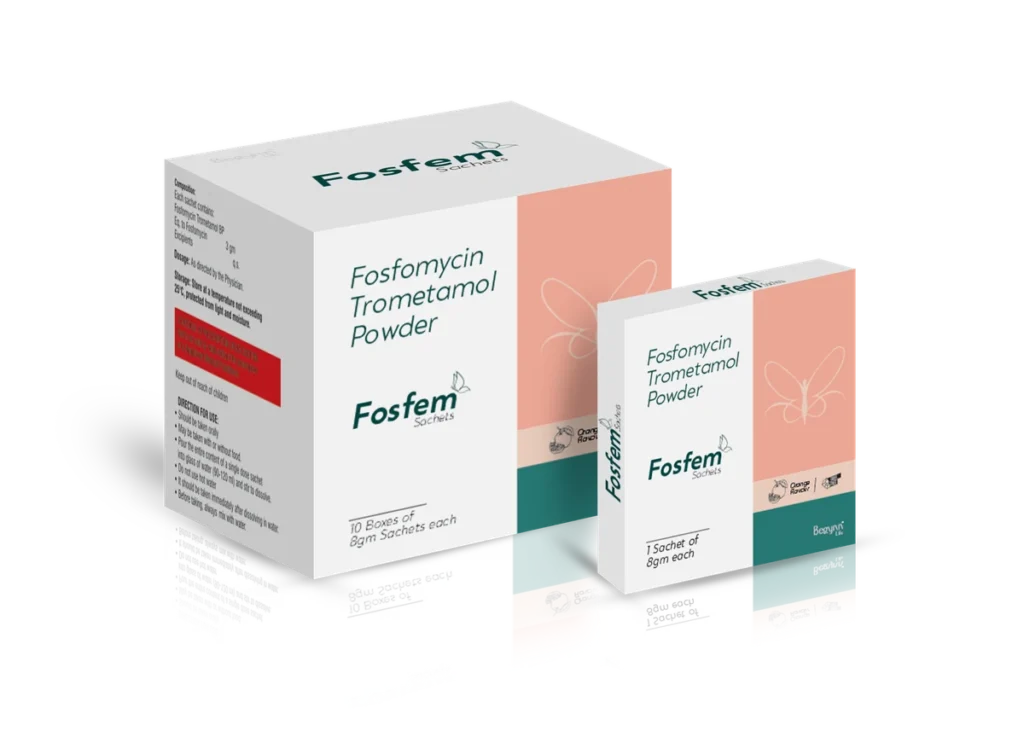
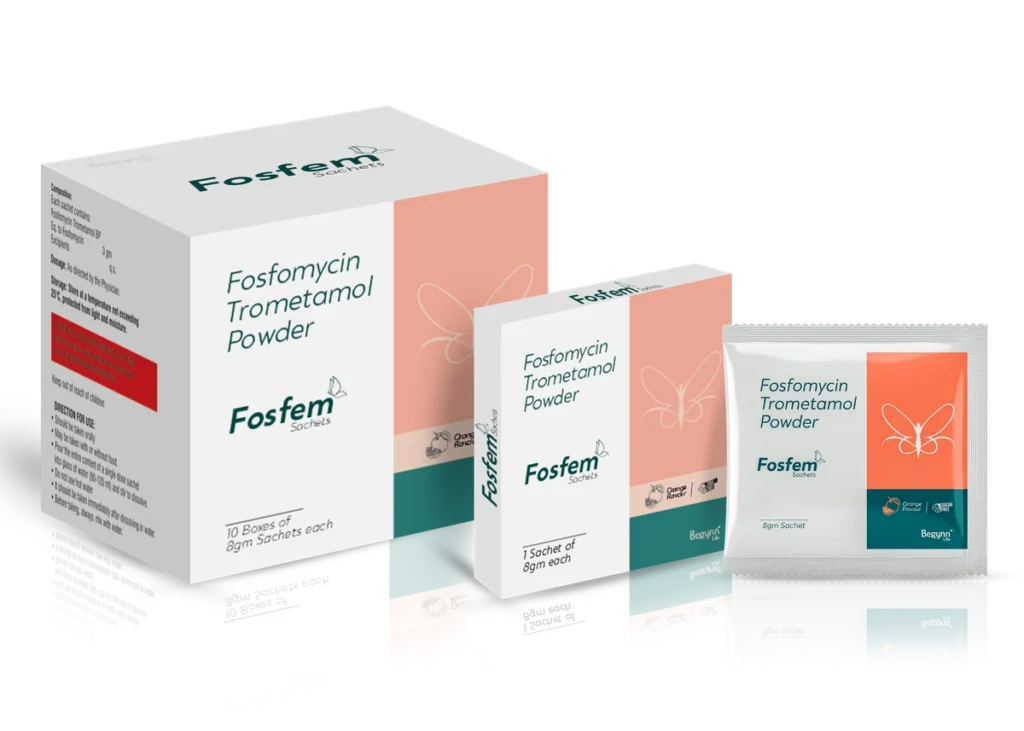
FOSFEM
Fosfomycin Trometamol Oral Powder
Quick Facts
Key Benefits
Mechanism of Action
Fosfomycin is a phosphonic acid antibiotic with a mechanism entirely distinct from all other antibiotic classes — it inhibits the very first committed step of bacterial cell wall synthesis. Specifically, it irreversibly inhibits MurA (UDP-N-acetylglucosamine enolpyruvyl transferase), the enzyme that catalyses the transfer of an enolpyruvyl group from phosphoenolpyruvate to UDP-N-acetylglucosamine — the first step in the synthesis of muramic acid, the precursor to peptidoglycan.
This unique mechanism of action has two critical clinical implications. First, fosfomycin has no cross-resistance with any other antibiotic class — bacteria resistant to all beta-lactams, fluoroquinolones, aminoglycosides, and sulphonamides remain fully susceptible to fosfomycin if they lack specific fosfomycin resistance mechanisms. Second, fosfomycin resistance mutations (primarily in the GlpT transporter gene responsible for fosfomycin uptake) emerge readily in vitro but are pharmacodynamically suppressed in vivo by the exceptionally high urinary drug concentrations achieved after oral administration.
Fosfomycin trometamol, the orally bioavailable prodrug, is hydrolysed in the gut to release fosfomycin, which is absorbed (bioavailability ~37–41%) and excreted almost entirely unchanged in urine — achieving urinary concentrations of 1000–4000 mg/L at 2–4 hours post-dose, maintaining concentrations above the MIC for susceptible organisms for 24–48 hours after a single dose.
This urinary pharmacokinetic profile — achieving concentrations 100–1000 times the MIC for susceptible E. coli, Enterococcus faecalis, and S. saprophyticus in urine — combined with the long urinary half-life, is the pharmacological basis for the landmark single-dose, single-sachet fosfomycin treatment for uncomplicated UTI.
Indications
FOSFEM is indicated for bacterial urinary tract infections, particularly where a single-dose treatment is clinically appropriate or where multi-drug-resistant organisms require fosfomycin as a last-resort oral option.
Uncomplicated Lower UTI (Primary Indication): A single 3gm fosfomycin trometamol sachet (dissolved in water) achieves 85–90% clinical and microbiological cure rates for uncomplicated cystitis caused by E. coli and Enterococcus faecalis — equivalent to 3–7 day courses of nitrofurantoin or trimethoprim-sulphamethoxazole. The single-dose regimen is the most compliance-assured antibiotic treatment available.
ESBL-Producing E. coli UTI: A rapidly growing indication of critical importance. ESBL E. coli is resistant to all cephalosporins and fluoroquinolones — leaving oral treatment options extremely limited. Fosfomycin retains activity against many ESBL E. coli strains (70–90% susceptibility rates in clinical series), making it one of the few oral options for ESBL UTI in non-pregnant adults.
Recurrent UTI Prophylaxis: Single-dose fosfomycin every 7–10 days as prophylaxis for women with recurrent UTI — an evidence-based regimen that avoids the continuous antibiotic exposure associated with daily prophylaxis.
Pregnancy UTI: Fosfomycin is considered safe in pregnancy (FDA category B) — an important clinical distinction in a patient population where most standard UTI antibiotics (fluoroquinolones, trimethoprim) are relatively or absolutely contraindicated.
Complicated UTI: Multiple-dose fosfomycin (every 48–72 hours for 7–21 days) for complicated UTI and pyelonephritis — an off-label but evidence-supported use in patients with limited alternatives.
Dosage & Administration
Dosage and administration should be as prescribed by a qualified doctor or medical professional. Do not self-medicate. Always follow your physician's instructions regarding dose, frequency and duration of treatment.
Why FOSFEM?
Fosfomycin occupies an increasingly critical position in Indian urology and infectious disease practice as the ESBL UTI crisis deepens. With ESBL-producing E. coli now accounting for over 50% of community UTI isolates in many Indian cities, and with fluoroquinolone resistance approaching 60–80% in some regions, the oral treatment options for uncomplicated and complicated UTIs have dramatically narrowed. Fosfomycin's unique mechanism — targeting an enzyme pathway entirely unaffected by ESBL production or fluoroquinolone resistance mechanisms — makes it pharmacologically reliable in the resistant-organism landscape that most other oral antibiotics are failing to navigate.
The single-dose convenience is the defining patient experience of fosfomycin therapy. For women with uncomplicated cystitis — already uncomfortable and symptomatic — the prospect of one sachet of medicine dissolving in a glass of water and providing cure without further doses represents a profound compliance advantage. Studies consistently show that single-dose fosfomycin achieves clinical cure rates equivalent to 3–7 day nitrofurantoin or trimethoprim courses despite the lower total drug exposure — driven by the extremely high urinary concentrations achieved.
FOSFEM at ₹4899 is priced at the premium specialist segment — reflecting the clinical value of ESBL UTI treatment capability and the unit-dose sachet manufacturing complexity. For franchise partners in urban markets where ESBL awareness is high and urologists actively seek oral alternatives to parenteral carbapenems, FOSFEM represents a high-value, scientifically differentiated product with a compelling clinical narrative.